
Hope in Action: What We Learned at Nordic Edge Expo 2026
The tenth edition of Nordic Edge Expo brought together leaders, innovators and city-builders from across Europe for two days of honest conversations about the world as it is – and what it demands of us. The theme was Hope in Action. Not optimism without responsibility, but hope grounded in what we actually do next. Here is what they found when they got in the same room.
Video: Aftermovie
There are plenty of conferences about climate change. Plenty about AI, about urban mobility, about food systems and digital government. What is harder to find is a place where all of these conversations happen at once – where the security expert, the insurance actuary, the urban farmer and the city planner sit in the same room and realise they are all working on the same problem from different angles.
That is the idea behind Nordic Edge Expo. And at this year's tenth edition in Stavanger, the timing felt particularly sharp.
“Most conferences go deep into one topic, says Inger Hanne Vikshåland, the event's project leader. “What we are trying to create here is something different – the shared reference points that make it possible for people from very different sectors and disciplines to actually work together. You can't collaborate across silos if you've never been in the same room.”
A world that doesn't arrive one crisis at a time
The morning opened with a provocation. Vice Admiral Louise K. Dedichen, former Norwegian Military Representative to NATO, gave the audience an unflinching account of a Europe under pressure – daily cyberattacks, a war in Ukraine she described plainly as "our war," and a security landscape changing faster than most governments have been willing to admit. "We are not at war in Norway," she said. "But we are not at peace either."
-03496%20(1).jpg?width=2800&height=1868&name=NordicEdgeExpo_by_AmundJanssen(@amundj)-03496%20(1).jpg)
Image: Louise Dedichen on stage
Futurist Lars Rinnan followed – not to contradict her, but to complete the picture. The same world Dedichen described is also one in which exponential technology is arriving faster than most people expect. Solar energy is becoming the cheapest ever produced. Computing power is doubling on a curve that will, by 2029, put the processing capacity of the human brain into a thousand-dollar device. "All of this is a design choice," Rinnan said. "It's up to us. Not the robots."
The tension between those two perspectives – the gravity of the moment and the scale of the opportunity – ran through the entire day.
The tools exist. The missing piece is connection.
What struck many participants was not a lack of solutions, but a lack of connection between them. Arnoud Molenaar, who spent a decade as Chief Resilience Officer for the City of Rotterdam, showed how one of Europe's most climate-vulnerable cities turned its geography into a design challenge – building water squares that double as public spaces, floating neighbourhoods, and tidal parks that reduce wave force while creating new habitat. Line Gjengedal Ruud from If Insurance brought harder numbers: extreme weather already costs Norway 5.5 billion kroner annually, rising to 19 billion by 2100 without intervention. One krone invested in prevention saves six in recovery costs.
-04526%20(1).jpg?width=2800&height=1868&name=NordicEdgeExpo_by_AmundJanssen(@amundj)-04526%20(1).jpg)
Photo: Lene Gjengedal Ruud from IF Insurance on stage
And Eirik Gundegjerde from Lyse pointed to an opportunity that is currently being missed at scale: the enormous heat pouring out of data centres – enough from a single 100-megawatt facility to supply 25 to 30 large greenhouses – could anchor entirely new industries, if only someone asked the right question at the planning stage.
“That is exactly the kind of conversation that doesn't happen when everyone stays in their own silo, Vikshåland reflects. “The data centre people and the food production people are not naturally in the same room. But they should be.”
We are designing ourselves away from nature – and from each other
One of the day's more quietly unsettling moments came from Carmen Garcia Sanchez, a researcher at the Royal Danish Academy of Architecture and consultant for the European Commission's New European Bauhaus initiative. Her data was simple and striking: citizens in Europe spend on average 90% of their time indoors in artificial environments. Children today spend 50% less time playing outdoors than their parents' generation – averaging just over four hours a week. A study of more than 800 European cities found that fewer than 15% of the population has adequate access to green space by any reasonable measure.
The consequences, Garcia Sanchez argued, are not just aesthetic. Regular contact with nature reduces stress, lowers blood pressure, strengthens social cohesion and can even reduce urban violence. These benefits can occur in as little as five to twenty minutes of immersion in nature. And yet the way we design cities is systematically making that contact harder to come by – and doing so most severely in the neighbourhoods that can least afford it.
Cities are ready. The system is not.
Perhaps the day's most urgent diagnosis came from Thomas Osdoba, Managing Director of NetZeroCities – the EU platform supporting 100 cities on the path to climate neutrality by 2030. The barrier to progress, he argued, is not technology, citizen willingness or city-level ambition. It is the incoherence between European, national and local governance. Cities have been leading on climate action for thirty years. They are closest to citizens. They are the most accountable. And yet they are being asked to deliver without the authority, resources or policy alignment to do so.
"Right now we are walking and trying to figure out how to walk faster," Osdoba said. "They need different shoes. We need a track and we need fuel."
-06392.jpg?width=2800&height=1868&name=NordicEdgeExpo_by_AmundJanssen(@amundj)-06392.jpg)
Photo: Thomas Osdoba in the panel about leading in times of change
Karin Ekdahl Wästberg from the City of Stockholm showed what running looks like when the conditions are right: three decades of patient investment in innovation infrastructure, 18 university partnerships, quantum communications running through fibre laid in 1994, and a fully electrified construction site procured through public purchasing power. The lesson she drew was deceptively simple: seeing is believing. Show that something works, and others will follow.
-06028%20(1).jpg?width=2800&height=1868&name=NordicEdgeExpo_by_AmundJanssen(@amundj)-06028%20(1).jpg)
Photo: Karin Ekdahl Wästberg telling Stockholms innovation story
The human layer
Some of the day's most lasting moments came not from policy frameworks but from stories about people.
Thomas Snellman, the Finnish farmer who founded the REKO ring – a direct trading model between farmers and consumers now active in nearly 20 countries – described what happened when farmers and consumers began meeting each other face to face. One farmer, he said, had completely lost hope before the concept was introduced. Knowing the people who ate his food gave it back.
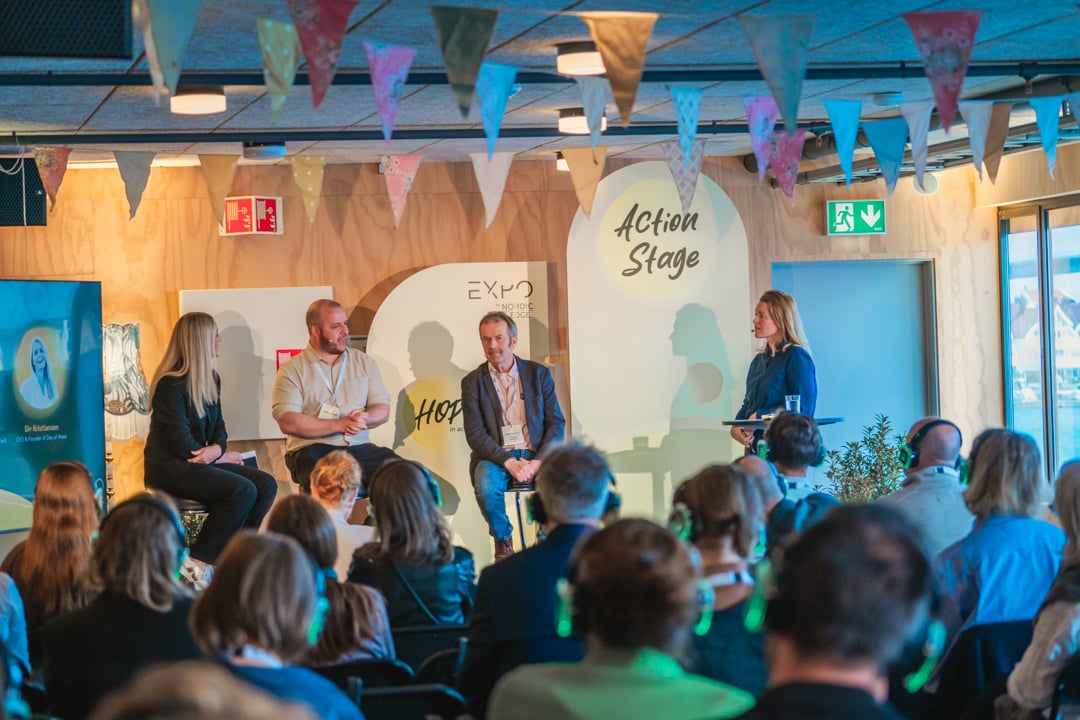
Photo: Panel about Nordic Food Systems. From the left: Siv Kristiansen, Mark Horler, Thomas Snellmann and Bothild Nordsletten
Birna Iris Jónsdóttir, CEO of Digital Iceland, closed the day with a different kind of resilience story. When the town of Grindavík was consumed by volcanic lava, her team had emergency information systems, rental platforms and property purchase applications running for 3,800 displaced residents within days. That speed was only possible because the digital foundation had been built patiently over years. "This is how important digital resilience is," she said. "For a volcanic nation."
-06655%20(1).jpg?width=2800&height=1868&name=NordicEdgeExpo_by_AmundJanssen(@amundj)-06655%20(1).jpg)
Photo: Birna Iris Jónsdóttir, CEO of Digital Iceland
What the tenth edition taught us
Looking back on a decade of Nordic Edge Expo, Vikshåland is struck less by any single speaker or session than by what happens between the sessions – in the corridors, over lunch, in the conversations that start with "I heard you are working on that too."
“The problems we are facing don't respect sector boundaries”, she says. “Climate change affects food security affects social inequality affects security policy. You can't solve any of them in isolation. What we need are shared reference points – a common language, common stories, common experiences. That is what this expo tries to create.”
The full summary from Nordic Edge Expo 2026 is coming soon.
-06862%20(2).jpg?width=2800&height=1868&name=NordicEdgeExpo_by_AmundJanssen(@amundj)-06862%20(2).jpg)
Photo: Our hosts - Hilde Sandvik, Marte Solheim and Bothild Nordsletten
Contact