
How can farmers pay for the green transition?
Crowdfunding, carbon credits, solar dryers and power from the farm. On 4 November, Ruralis and Nordic Edge brought researchers, farmers and companies together in Stavanger and online to look at new ways to finance farming. Ruralis put together the programme and leads three of the research projects presented, and Nordic Edge hosted the day at Innoasis.
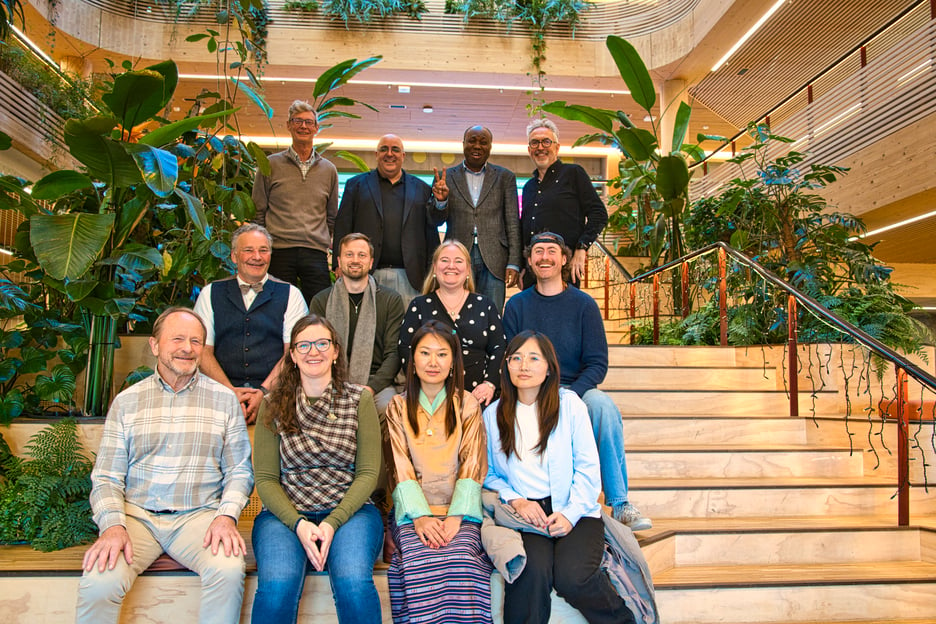
More than 30 people signed up for the seminar Sustainable Business Models and Alternative Financing in Agriculture, held at Innoasis and on Teams. Researchers from Norway and Bhutan presented results in the morning. After lunch, farmers and companies shared what it takes to make these models work in practice.
The question behind the day was simple. Farmers are expected to cut emissions, protect nature and keep food production going, often on small margins. Who pays for it?
“Norway is not the centre for venture capital in the world, so we need to look for alternatives,” said Rotem Shneor, Professor of Entrepreneurship at the University of Agder, in the first talk of the day.
Crowdfunding is growing. Many farmers have never heard of it.
Rotem Shneor leads a crowdfunding research centre at the University of Agder. He explained that NOK 2.5 billion was raised through crowdfunding in Norway in 2023, mostly as loans to property projects. Donation and reward campaigns make up only 1 to 3% of the volume. Equity crowdfunding is growing and fills a gap left by the small number of angel investors in Norway.
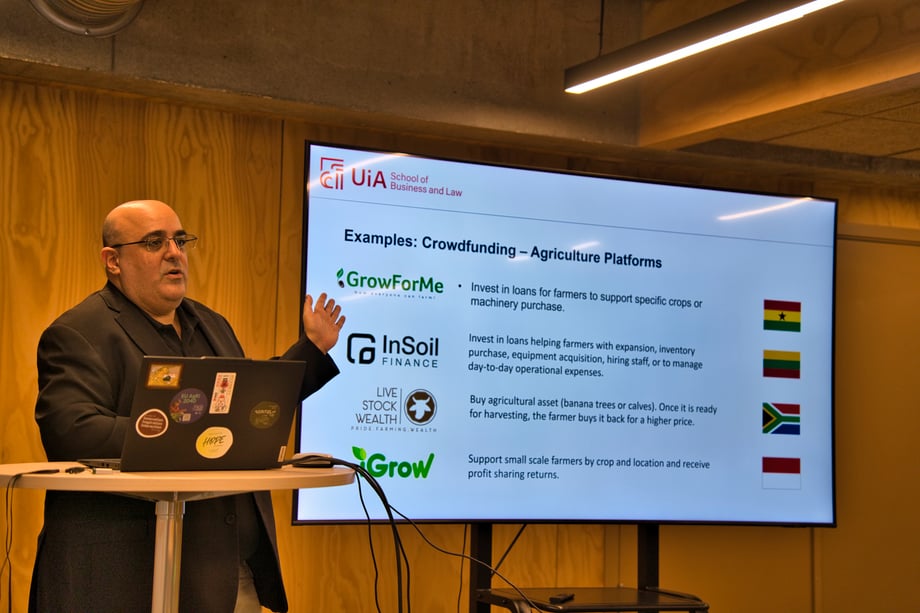
Platforms are strict about who gets in. Only 18% of applicants are approved for business loans and 9% for equity, yet 86 to 89% of approved campaigns reach their target. The campaigns that succeed show the people behind the project, share regular updates and spend months warming up their network before launch. Rotem also pointed to dedicated agricultural platforms in Ghana, Lithuania, South Africa and Indonesia, where investors fund crops, machinery or livestock and get a share of future income.
Pia Piroschka Otte, Research Professor at Ruralis, followed with results from the CoolCrowd projects. A survey of 465 Norwegian farmers found that only 19.2% knew about crowdfunding. Farmers preferred donation and reward campaigns over loans, and many wanted to run campaigns together with other farmers. Pia linked this to the Law of Jante, since a campaign means putting yourself and your farm on show.
The team then tested two real campaigns. A couple on a mountain summer farm raised money for solar panels and a battery, helped by frequent updates on social media, personal photos and rewards such as homemade cheese. A biochar campaign in Eastern Norway with fewer updates did not reach its goal. Most of the 82 backers of the solar campaign wanted no reward at all. They simply liked the story. The results are published in the Baltic Journal of Management.
Carbon credits take years to pay off
Natalia Mæhle, Professor at Western Norway University of Applied Sciences (HVL), presented early findings from Karbonmat, a project led by Ruralis with HVL as a research partner. The team has studied eleven European providers of carbon credits from farms, as well as four in Australia, and interviewed Norwegian companies that buy credits.
Trust is the most important currency in this market, which makes measurement and certification the largest costs. Farmers often need to change their practices for five to seven years before credits can be sold. Norwegian buyers prefer local credits they can trace, but the volume in Norway is still small, and interest in nature credits is rising. Natalia’s team suggests a blended model where public funding supports farmers in the early years, with banks and insurers brought in along the way.
A solar dryer only helps if farmers can use it
Isabelle Hugøy, Researcher at Ruralis, and Kinley Yangdon from Gedu College of Business Studies at the Royal University of Bhutan presented SolarFood. The project is led by Ruralis, funded by the Research Council of Norway and runs until 2028, with partners in Bhutan, Nepal and Sweden.
In Bhutan, more than 40% of the harvest can be lost after harvesting, and in Nepal between 20 and 50%. Improved solar dryers can cut those losses, and the project works with women-led cooperatives, since women do most of the drying. The first prototype could dry 30 to 40 kg but was too large to move to the villages. A smaller 10 kg version is now being tested with pumpkin, lemon, ferns, cardamom and banana.
“Farmers should be able to make use of it. Otherwise there is no purpose in developing it,” said Kinley Yangdon, who has also met six financial institutions in Bhutan to map loans that could help cooperatives buy the dryers.
Why good pilots stall
Einar Vastveit founded Agrosense in 2019. At the heart of Agrosense is a hyperlocal sensor system that measures conditions in each field. It gives the farmer insights and predictions, and the system learns over time. Many digital tools in agriculture are built to help authorities track income, grants and nutrient use. Agrosense builds for the farmer, with a solution that can follow the farm from conventional to regenerative practices and make it possible for the farmer to get paid for the change.
Einar grew up on a farm and gave an honest picture of the market. Agriculture is large and well organised through cooperatives, and there is plenty of research funding. At the same time, margins are small, regulation is strict and farmers invest heavily. A new barn costs NOK 8 to 15 million.
Einar Vastveit pointed to soil sampling as one of the main barriers in carbon farming today. A carbon project needs a baseline of samples, and then new samples five to ten years later, before anyone knows what has been stored. The cost of all this sampling can eat up much of the value of the carbon credits.
Carbon is also only part of the picture, Einar said. If a farm loses productivity while earning carbon credits, both the farmer and society can lose more than the credits bring in. Agrosense aims to find that balance on each individual farm. In the panel he added that a solution has to respect the knowledge farmers have built up over generations, and that founders need to fit the market as well as the product.
Power, nature and preparedness in one package
Nito Simonsen from Green River and Climate Point joined online and presented Grønn Gårdsenergi together with farmer Kjell Ivar Ueland and Gunnar Crawford, Head of Agritech at Nordic Edge. At Røysland Gaard in Bjerkreim, solar panels are already in place, batteries are being installed and wind turbines are planned.
The idea is to sell more than electricity. Buyers can pay for guarantees of origin, for nature compensation and for preparedness, which means farms that keep producing food and clean water if the power grid goes down. Selling 10 GWh at 1 euro cent per kWh would bring around EUR 100,000 back to four or five farms. Nine more farms in the region are waiting to join, with the first expected by the end of 2027.
Kjell Ivar Ueland described four levels of preparedness, from running the farm without diesel to agreements with the municipality and the armed forces. For him, the farmer should own the equipment, and the control system should be simple enough for any farmer to use.
Small pieces of a bigger pie
The day closed with a panel of all speakers, moderated by Gunnar Crawford. Rotem Shneor was sceptical that crowdfunding and carbon credits will merge, since crowdfunding is about individuals while credit markets are mostly between companies. Pia Piroschka Otte stressed that emission cuts must be made visible and easy to relate to. Nito Simonsen argued that the 30 to 40% margins taken by credit issuers have to come down so more of the value reaches the farmer.
A question from the online audience reminded the panel that Norwegian farmers have a duty to live on and run their farms. Gunnar Crawford answered that crowdfunding, carbon credits, energy and preparedness can be seen as pieces of the same pie. Together, they can give farmers a more stable income. Pia Piroschka Otte added that about one and a half farms close in Norway every day, and called for policies and institutions that connect the many schemes farmers face today.
“Let’s see the value that farmers bring. It’s so important for society,” said Nito Simonsen in his closing remark.
What this means for our members
More of what farms need, such as energy systems and soil sensors, is now sold as a service instead of bought outright. For the farmer, that lowers the investment up front. For the companies in Nordic Edge Agritech, it means the business model matters as much as the technology: who pays, how often, and what the farmer gets in return. Several of the members who build these services were in the room or on Teams.
Nordic Edge will follow up with more seminars on new business models in agriculture. Members who want to test crowdfunding, carbon credits or energy sales on their own farm or product can contact Gunnar Crawford at gunnar@nordicedge.org.
Speakers and talks
- Introduction to crowdfunding. Alternative funding for sustainability
Rotem Shneor, Professor of Entrepreneurship, University of Agder - CoolCrowd projects. Crowdfunding climate mitigation measures in Norwegian agriculture
Pia Piroschka Otte, Research Professor, Ruralis - Karbonmat. Sustainable business models for carbon sequestration in soils
Natalia Mæhle, Professor, Western Norway University of Applied Sciences (HVL) - Sustainable and inclusive business models for solar food drying. Preliminary insights from SolarFood
Kinley Yangdon, Gedu College of Business Studies, Royal University of Bhutan, and Isabelle Hugøy, Researcher, Ruralis - Challenges in developing sustainable business models in agriculture
Einar Vastveit, Founder, Agrosense AS - Power from the farm: energy and preparedness as a new income stream
Nito Simonsen, Green River and Climate Point, Kjell Ivar Ueland, Røysland Gaard and Nyyyt, and Gunnar Crawford, Head of Agritech, Nordic Edge - Panel discussion
All speakers, moderated by Gunnar Crawford