

Romvesen Takes Drone Technology to New Heights
With a combination of technological curiosity, practical experience, and a willingness to challenge established solutions, Romvesen has grown to become a major player in the Norwegian drone market. Now the company is turning its attention to agriculture, where drones can contribute to more efficient operations, less soil compaction, and new opportunities for sustainable food production.
Facts about Romvesen
Established: 2013
Member of Nordic Edge since: 2025
Industry: agritech
Where: Nordfjord
What: Develops drones and technological solutions for sectors including construction, energy and agriculture
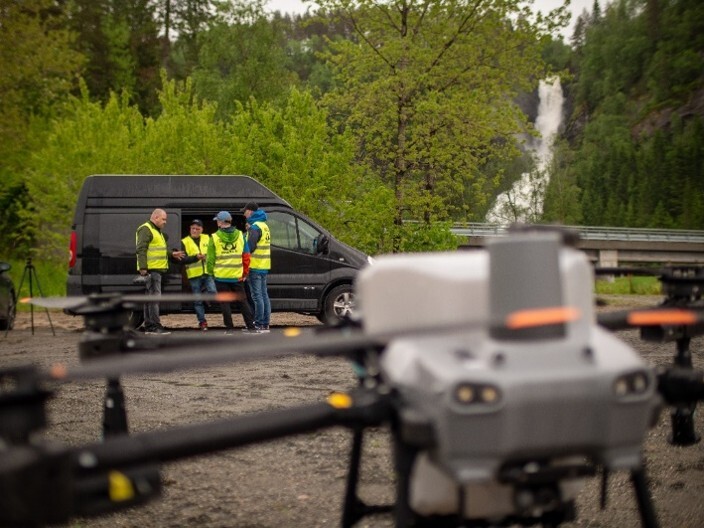
Drones That Solve Practical Challenges
The story of Romvesen began around 2012. After more than 10 years in the forestry industry, founder Ove Kristian Leirgulen wanted to explore the possibilities of using drones for wind turbine maintenance. Around the same time, they made a decision that would mark the start of a new direction for the company: to purchase a drone and explore the possibilities the technology could offer.
Since then, the range of applications has expanded significantly. Romvesen has built up expertise in several technical fields and is currently working on solutions that can be applied throughout various stages of the construction process, in the energy sector, and in agriculture. The company supplies not only drones but also equipment and sensors that make it possible to adapt the technology to various tasks. These include cameras, laser scanners, sonar, and other measuring equipment.
In addition, Romvesen has developed a system that simplifies the administrative aspects of drone operations, such as risk assessments, logging, and documentation. The goal is to make it easier and more affordable for customers to meet the requirements associated with drone use.
A Small Player with Big Ambitions
The drone industry is technically demanding and evolving rapidly. At the same time, companies must comply with extensive regulations regarding safety and operational use. For Romvesen, navigating these regulations has been a challenge throughout its journey. Competition has also intensified as more companies have become aware of the technology.
Nevertheless, a project from 2017 illustrates what smaller players like Romvesen can achieve. On Andøya, Romvesen participated in testing ground-penetrating radars mounted on drones, in collaboration with FlyLavt and the Norwegian Public Roads Administration. The work was part of research into snow conditions and the potential to improve our understanding of avalanches. Romvesen brought a homemade drone from Bodø and radar equipment from a Swedish manufacturer. In the testing, the company achieved the best results.
“We were a small company with a homemade drone, but we managed to hold our own against larger technology firms. This shows that you don’t have to be big to get things done,” says Ove Kristian Leirgulen, CEO and managing director of Romvesen.
Focus on Agriculture
Romvesen operates in several sectors, but at the moment, agriculture stands out as a particularly important focus area. The company is working to establish an operational system for drone use that can cover all of Norway. A key part of this effort is ensuring that farmers receive the necessary training and that a service and maintenance infrastructure is in place for when the drones are used in daily operations.
Romvesen collaborates with Fagskulen Vestland on training and with Norsk landbruksrådgivning (Norwegian Agricultural Extension Service) on, among other things, research into operational ranges. In Rogaland, the company is working with Skårland Agri Drone to develop a local service and maintenance offering.
For drones to become a practical tool in agriculture, farmers must have access to expertise, support, and equipment suited to the tasks they need to perform. At the same time, regulations are a key factor. The use of drones for aerial spraying and treatment is subject to restrictions, and further development therefore depends, among other things, on how these regulations are implemented and refined.
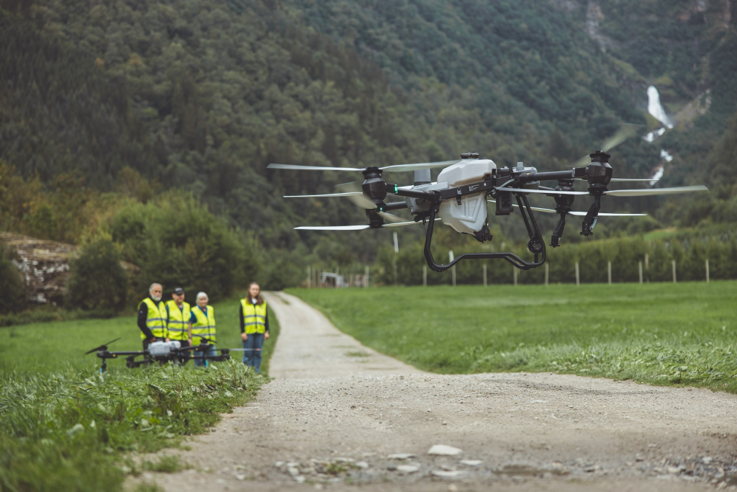
Image: Romvesen drone
From hours to minutes
One of the advantages of drones is that they can perform tasks in places where traditional machinery has limited access.
Ove Kristian cites a large fruit orchard in Hardanger as an example. The orchard is located on steep terrain, which makes it difficult to use a tractor. Fertilization therefore had to be done manually and used to take several hours. With a drone, the same task could be completed in about three minutes.
This example illustrates how the technology can significantly reduce the time required and simplify demanding tasks. In areas with steep terrain or difficult access, this can be particularly valuable.
Drones can also reduce the need to drive heavy machinery on the fields. Fewer tire tracks can help minimize soil compaction, and precise application may offer opportunities to reduce the use of pesticides, depending on the method and regulations.
The technology can also make certain tasks in organic farming more manageable. When treatments and other tasks can be performed more quickly, it may become easier to implement farming methods that otherwise require a great deal of manual labor.
For Romvesen, the agricultural initiative is therefore not just about introducing a new type of machine, but about exploring how the technology can help solve specific challenges in agriculture.
New Perspectives
For Romvesen, it’s important to connect with stakeholders who can offer new perspectives and open doors to new opportunities. Through Nordic Edge, the company has, among other things, participated in a gathering at Øksnevad, where agriculture and technology converge.
“We must be open to new opportunities and figure out how the technology can be applied in new areas. There’s a lot happening in drone technology, and it’s important to keep up with developments,” says Ove Kristian.
With new applications emerging in agriculture and a rapidly evolving market, Romvesen continues to explore how drones can solve practical challenges. For the company, it’s about seeing the possibilities in the technology and figuring out how to turn them into solutions that work in practice.
"Romvesen demonstrates how technology from other fields can solve specific problems in agriculture. It has literally given them a flying start. I particularly like that they’re leveraging other players in the cluster. Together, we’re building an industry with reliable services that provide direct value to farmers,” says Gunnar Crawford, head of agritech at Nordic Edge.
Three questions about the journey
With Ove Kristian

What is one thing you would do differently if you were starting today?
– I would carefully consider the opportunities and be even more aware of the time and perseverance required to build a business. At the same time, the journey has provided valuable lessons along the way.
Is there anything that has surprised you along the way?
– How long it can take to turn new ideas and solutions into reality. It requires patience, determination, and the ability to stay true to what you believe in.
What are you looking forward to in the future?
– I’m looking forward to an event we’re organising with Norsk Bonde- og Småbrukarlag towards the end of the year, as well as continuing our work on a research project, skills development and training programmes. There’s a lot of exciting work ahead, but first, I’m off to pour some concrete!